





Why Promeg® and Corflute® Are the Sustainable Alternative to Cardboard in Circular Packaging
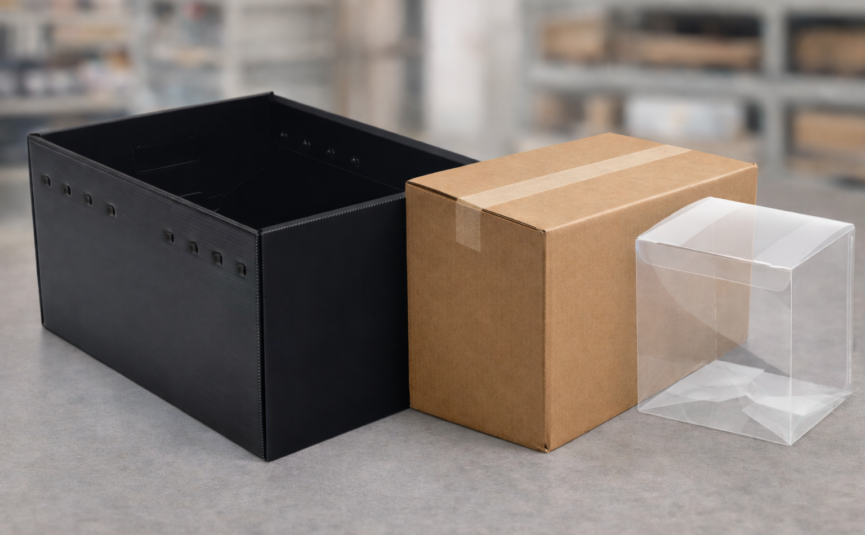
Australia’s packaging landscape is rapidly evolving. Under the guidance of the Australian Packaging Covenant Organisation (APCO), businesses are being called to move beyond linear “make–use–dispose” models and adopt circular economy principles that prioritise material efficiency, reuse and recovery.
While cardboard and paperboard are often perceived as sustainable by default, a full lifecycle assessment reveals significant environmental trade-offs. In contrast, materials such as Promeg® polypropylene sheet and Corflute® fluted polypropylene are designed to align more closely with APCO’s core objectives: designing out waste, keeping materials in use, and reducing environmental impact across the supply chain.
APCO National Packaging Targets
Corflute®’s & Promeg®’s Alignment
1. 100% reusable, recyclable, or compostable packaging – Strong Alignment
- Corflute® and Promeg® are designed for reuse first, which sits at the top of APCO’s waste hierarchy.
- Both materials are recyclable polypropylene (PP) at end of life, where suitable recycling streams exist.
- While they are not compostable, APCO recognises reuse and recyclability as equally valid pathways.
2. 70% of plastic packaging being recycled or composted – Strong Alignment, but requires stakeholders to support Australian Made Corflute®
Corflute® and Promeg® are fully recyclable plastics, but this target depends on:
- Purchasing Australian Made Corflute® and Promeg® – ALL materials can be returned to Corex Recycling and will be remanufactured
- Collection systems
- End-user behaviour
- Access to PP recycling infrastructure or Corex Recycling only when using genuine Corflute® and Promeg – made in Australia.
It’s important to keep in mind that Corflute®’s and Promeg®’s durability and reuse reduce the frequency at which material enters the waste stream, lowering overall waste generation.
3. 50% average recycled content included in packaging – Strong Alignment but application dependent
Corflute® and Promeg® can be manufactured with recycled PP content, subject to:
- Performance requirements
- Colour, strength and regulatory needs
- In reuse-focused applications, lifecycle performance often delivers better environmental outcomes than recycled content alone.
In simple terms, Corflute® and Promeg® can include recycled content like in the Corex Sustainability Range (where all products include a minimum 50% recycled content), but their biggest sustainability benefit comes from long life and repeated reuse.
4. The phase-out of problematic and unnecessary single-use plastics packaging – Very Strong Alignment
- Corflute® and Promeg® are not single-use materials.
- They are intentionally designed to replace disposable cardboard and short-life packaging.
- Their use directly supports APCO’s goal of eliminating unnecessary single-use packaging by keeping materials in circulation.
In summary, Corflute® and Promeg® help replace single-use packaging with reusable systems, which is exactly what this target aims to achieve.
Cardboard V's Promeg® & Corflute®
Re-examining Cardboard Through a Circular Economy Lens
Cardboard’s environmental profile is often judged on recyclability alone. However, APCO’s framework emphasises whole-of-lifecycle performance, including resource consumption, durability and reuse potential.
High water intensity
Producing one tonne of virgin paper can consume up to 78,000 litres of water, while recycled paper still requires approximately 39,000 litres per tonne, placing ongoing pressure on freshwater resources.
Environmental pollution
Paper manufacturing generates effluent and chemical by-products that can negatively impact waterways and ecosystems, conflicting with circular economy goals of minimising environmental harm.
Energy-intensive processing
Even recycled cardboard typically requires 1.5 to 2 times more energy to produce than polypropylene sheet.
Low reuse capability
Cardboard’s susceptibility to moisture and wear limits its ability to remain in circulation, driving frequent replacement and increased material throughput.
When evaluated against APCO’s targets for waste reduction and material efficiency, cardboard’s limitations become increasingly clear.
Promeg®: Designed to Keep Materials in Use
Promeg® polypropylene sheet supports circular supply chains by prioritising durability, reuse and resource efficiency.
Significant water savings
Production requires approximately 9,000 litres of water per tonne, dramatically reducing pressure on water resources.
Closed-loop manufacturing
Promeg® is produced in a controlled process with no effluent discharge, supporting cleaner production outcomes.
Lower energy demand
Around 75 gigajoules per tonne, compared with 100–150 gigajoules for paperboard.
Reduced carbon impact over time
While initial production emissions may be comparable, Promeg®’s extended lifespan and multiple reuse cycles significantly reduce emissions per use, a key circular economy metric.
Built for repeated use
Waterproof and impact-resistant, Promeg® remains functional where cardboard fails, enabling longer circulation within supply chains.
Corflute®: Enabling Reuse at Scale
Corflute® builds on the benefits of solid polypropylene, delivering structural strength for applications where longevity and performance are critical.
Durable and weather-resistant
Well suited to signage, point-of-sale displays, reusable packaging and logistics systems.
Extended material life
Each Corflute® sheet can replace dozens of single-use cardboard alternatives, directly supporting APCO’s waste-avoidance objectives.
Resource-efficient design
While fluted polypropylene requires marginally more energy to produce than solid PP, it still consumes far less water and generates less pollution than paperboard.
Recyclable at end of life
Corflute® can be recovered through polypropylene recycling streams where available or when purchased through Corex or a distributor partner, helping close the material loop.
The Circular Path Forward
Delivering on APCO’s Packaging Targets
Replacing cardboard with Promeg® and Corflute® helps businesses progress toward APCO’s key goals:
- Designing out waste through durable, reusable materials
- Reducing virgin resource use by extending product lifespans
- Lowering environmental impact across the packaging lifecycle
- Supporting recyclability and material recovery at end of life
Every tonne of cardboard replaced delivers:
- Tens of thousands of litres of water saved
- Zero toxic effluent discharged
- Lower carbon emissions per use
- A high-performance material that remains in circulation longer
The Circular Path Forward
Under APCO’s circular economy framework, sustainability is no longer measured by recyclability alone, but by how effectively materials are designed, used, reused and recovered.
For organisations committed to responsible packaging and supply chain efficiency, cardboard represents a legacy solution built for linear systems. Promeg® and Corflute® offer a future-ready alternative, supporting circular outcomes while delivering superior durability, performance and environmental efficiency.
About Corex
Homegrown Solutions. Sustainably Designed.
Corex is a unique Australian closed loop business with polypropylene sheet extrusion, fabrication, and recycling all on one site.
We manufacture genuine Corflute®, a proprietary twin wall profile polypropylene sheet used broadly across the signage, supply chain, horticulture, and building industries. We also make HDPE and other specialty plastic solutions for industrial applications such as engineering, mining and infrastructure projects.
After merging forces with Megara, we added Promeg® polypropylene to our core product offering, broadening our industry scope to include retail display, consumer packaging, and custom presentation solutions.
Our products are intended for the long-haul – designed to be reused again and again!
Together, we deliver customers with an Australian closed-loop manufacturing, fabricated products, and recycling one-stop-shop.
Sign up for industry innovations, special offers and useful information.
"(Required)" indicates required fields